Creative & Performing Arts
Drama
The purpose of the Drama curriculum at The Archbishop Lanfranc Academy is to develop creative, confident and thoughtful young people. Through Drama, students develop emotional intelligence, self-confidence and the ability to express ideas and feelings, while also building important transferable skills including teamwork, communication, listening, resilience and problem-solving.
Students explore a wide range of plays, theatrical styles, practitioners and performance traditions through practical exploration, performance, design and written reflection. They learn how performers, directors and designers make purposeful creative choices to communicate meaning to an audience.
Our curriculum is both practical and academic. Students develop performance skills including voice, movement, characterisation and ensemble work alongside an understanding of lighting, sound, costume, set and other technical aspects of theatre. As students progress, they are increasingly expected to justify their artistic choices and to analyse and evaluate their own work and the work of others.
Students also have opportunities to experience professional theatre and live performance, developing their cultural capital and their ability to analyse theatre critically. They are introduced to the wide range of creative, technical and performance careers available within the performing arts.
Our Curriculum Journey
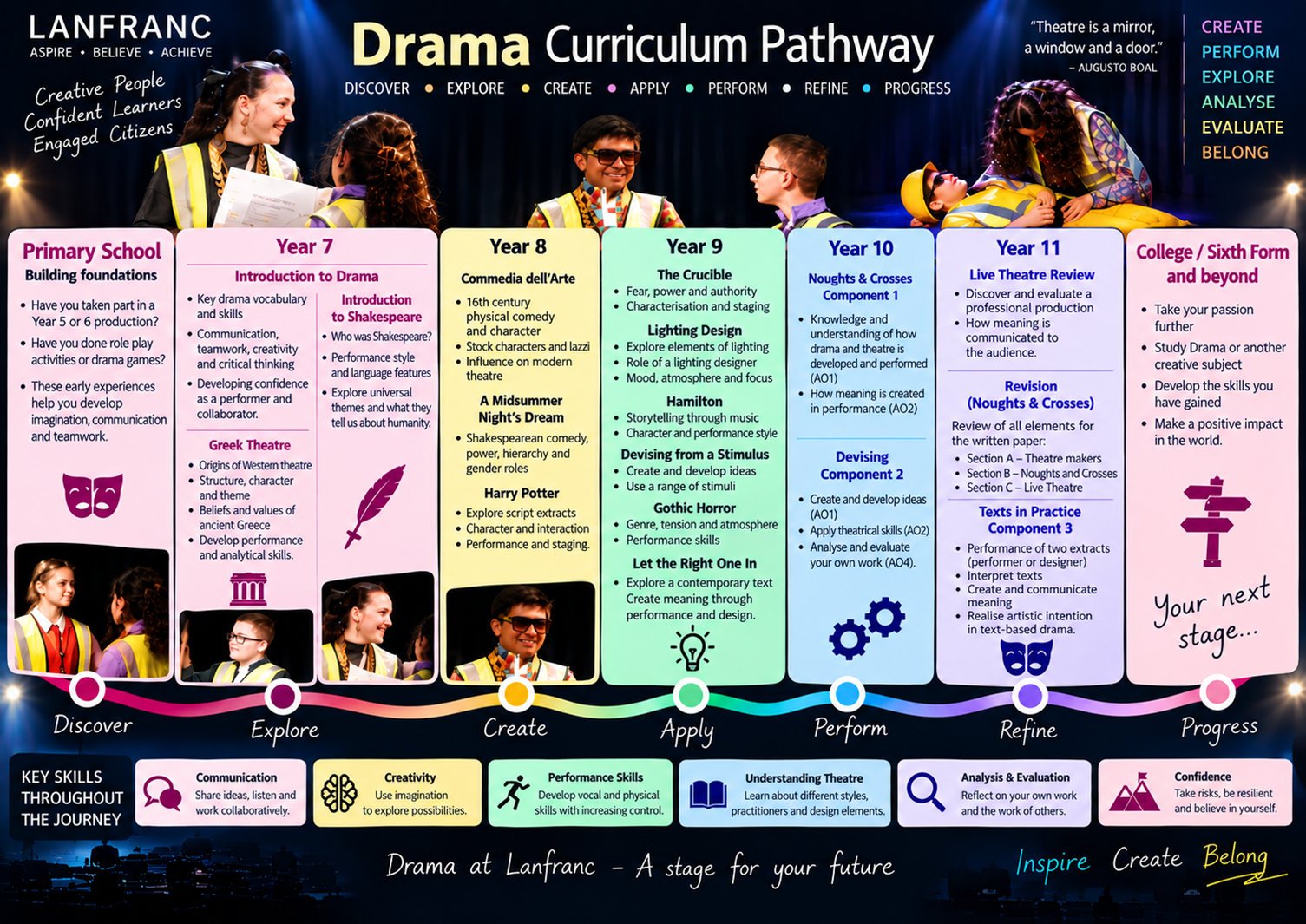
The Drama curriculum is carefully sequenced from Year 7 through to GCSE so that students continually revisit and develop their knowledge and skills.
In Year 7, students establish the foundations of successful Drama through voice, movement, characterisation, collaboration and ensemble performance. They explore the origins of Western theatre through Greek Theatre before applying and developing their performance skills through Shakespeare.
In Year 8, students encounter increasingly sophisticated theatrical styles and texts. Through Commedia dell'Arte, Shakespeare and contemporary theatre, they develop their understanding of status, relationships, comedy, physicality, character and audience communication.
In Year 9, students begin to bridge the gap between KS3 and GCSE Drama. They explore challenging texts and themes while developing greater precision and independence as performers, devisers and designers. Students study lighting design, respond creatively to stimuli and develop their ability to analyse, evaluate and justify theatrical choices.
At GCSE, students bring these strands together through the study of a set play, devised theatre, live theatre analysis and scripted performance.
Curriculum Overview
Year 7
Introduction to Drama → Greek Theatre → An Introduction to Shakespeare
Year 8
Commedia dell'Arte → A Midsummer Night's Dream → Harry Potter and the Cursed Child
Year 9
The Crucible → Lighting Design → Hamilton → Devising from Stimulus → Gothic Horror → Let the Right One In
Year 10 - GCSE
Noughts & Crosses: Set Play → Component 2: Devising Drama
Year 11 - GCSE
Live Theatre Review → Component 1: Noughts & Crosses and Written Examination Revision → Component 3: Texts in Practice → Final Examination Preparation
Beyond the Classroom
Drama at Lanfranc extends beyond curriculum lessons. Students are encouraged to participate in productions, performance opportunities, theatre visits and extracurricular Drama, giving them opportunities to work collaboratively, experience professional theatre and perform for different audiences.
Through these experiences, we aim to develop students who are not only confident performers but also creative thinkers, effective communicators and informed theatre-makers
Drama Learning Pathway
Our learning pathway shows how students' knowledge and skills develop from their first Drama lessons in Year 7 through to GCSE. Each unit builds upon previous learning while developing increasingly sophisticated skills in performance, devising, design, analysis and evaluation.
Exams
Exam Board
AQA
Course Title and Syllabus
GCSE Drama
Details
Students studying GCSE Drama develop as performers, theatre-makers and informed audience members. The course combines practical performance and devising with the study and analysis of theatre.
Component 1 - Understanding Drama
Students study Noughts & Crosses as their set play and develop their knowledge and understanding of how drama and theatre are created and performed. They also analyse and evaluate the work of live theatre makers.
This component is assessed through a 1 hour 45 minute written examination worth 80 marks.
Component 2 - Devising Drama
Students work collaboratively to create and perform an original piece of theatre in response to a stimulus. They research and experiment with different theatrical approaches and practitioners before developing, rehearsing and refining their own work.
Students also complete a Devising Log, documenting and evaluating their creative process.
The devised performance and accompanying log are internally assessed and externally moderated and are worth 80 marks.
Component 3 - Texts in Practice
Students develop and perform two extracts from a published play, demonstrating their ability to interpret text and communicate meaning to an audience through their performance choices.
This component is assessed by an external examiner and is worth 40 marks.